Pagey - from zero to validation (and why we sunset it)
It's not easy to come up with an app idea. It's even harder to give it up after you've spent time building it, but people do not care about it. How did we come up with an app idea, design, build it, and validate it? How and why did we decide that it's not it, and that we should move on?
Problem#
Personally, I had been struggling to create a CV while applying to a job and keeping all my sources, portfolio, CV, and LinkedIn up to date. I wanted to have a decent-looking website (ideally without having to code), a CV different than anyone else, and not having to spend hours on them, only for another recruiter to skip it.
It turned out that more people might have a similar problem, especially those who are non-technical. I talked with some and decided to build it with my partner, Natalia. We knew that we could not spend the next 6 months building it, that was clear. We took a shorter, yet effective path that we used before, but for projects for others.
Design#
After working together for some time, we were sure that we needed direction fast:
- Defined the problem.
- Brainstormed and mapped user flows and wireframes with potential solutions.
- Picked N ideas and made Figma designs out of them.
- Made v0 prototypes to decide whether our solutions are feasible.
We came up with this process during work for clients at knm. It's clearly based on the Design Thinking approach.
Once we were okay with the results of prototyping, we defined the initial sitemap (as it was clear what we needed), and Natalia jumped straight to Figma to define the most important parts of the application: builder (dashboard), auth, and then reusable sections.
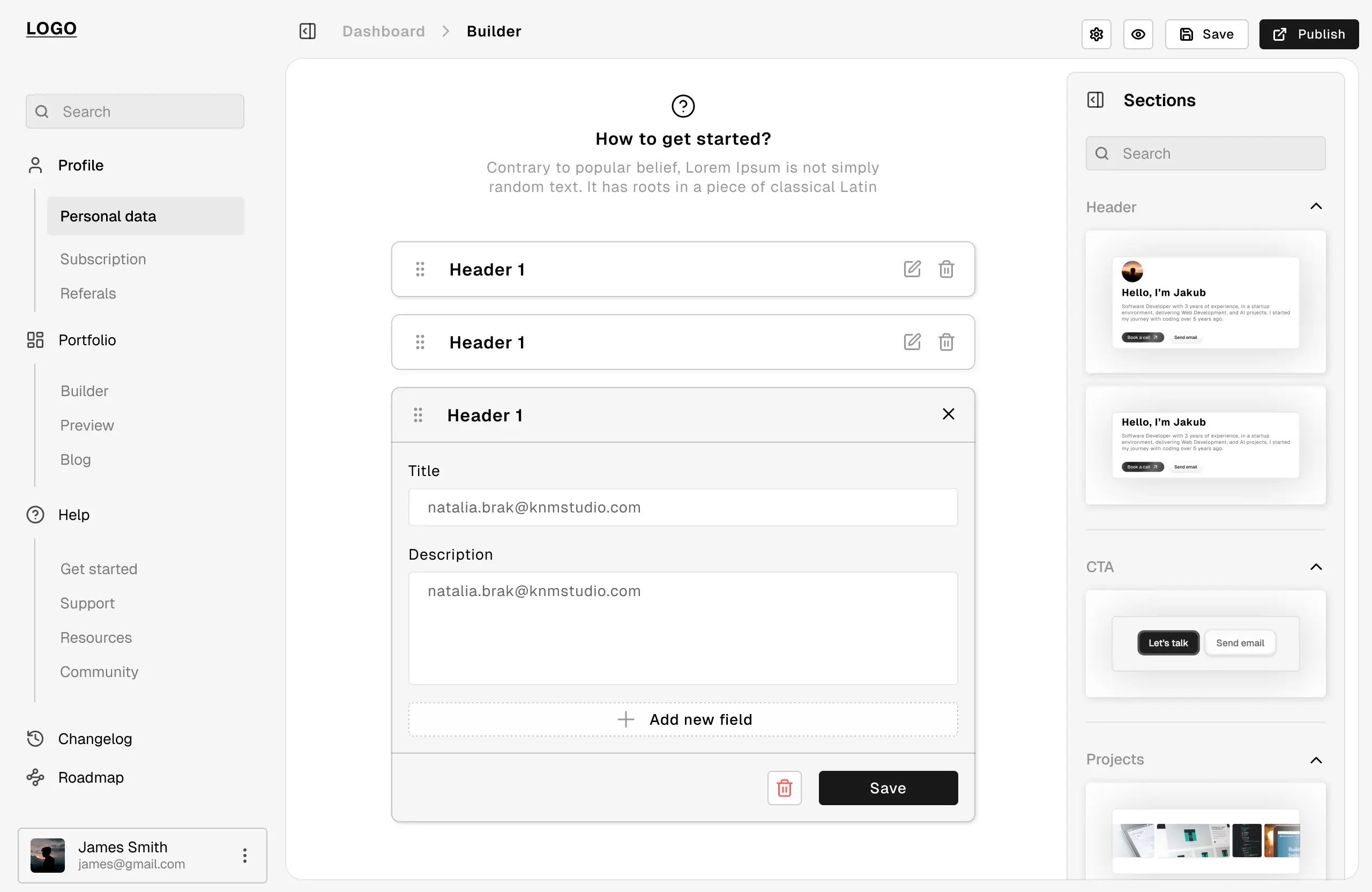
Initial Pagey design
Building MVP#
When designs were pending, I was preparing the backend for the app. I have my project template ready, so I did not have to spend that much time on that: Next.js app, with TypeScript, TailwindCSS, and Better Auth as an auth solution. What I always take care of is the data model.
After experience with several commercial and non-commercial projects, I know most of them will never change the database, nor will they refactor the data model. That's why I tend to make it right when starting the project, while still not having to spend more than a couple of hours on that.
Once setup was done and UI had been gradually delivered, I jumped into the code and started building the app. Without a doubt, the builder part was the most challenging: complex drag and drop functionality, a data model that has to match with available pre-made components, and a form builder that reflects the expected input of the components.
Once this was done, there was a straight line to the end. With extensive help of AI and already defined components and kind of the styleguide, I was able to get through all other screens and functionalities quickly. In the meantime, we had to prepare for the release.
Release#
It was clear to us that we needed to get in front of users ASAP. As the app itself was getting ready, Natalia created the landing page, so we could have all the software ready on time. Then she jumped into preparing banners, which we used for social media posts and directory releases.
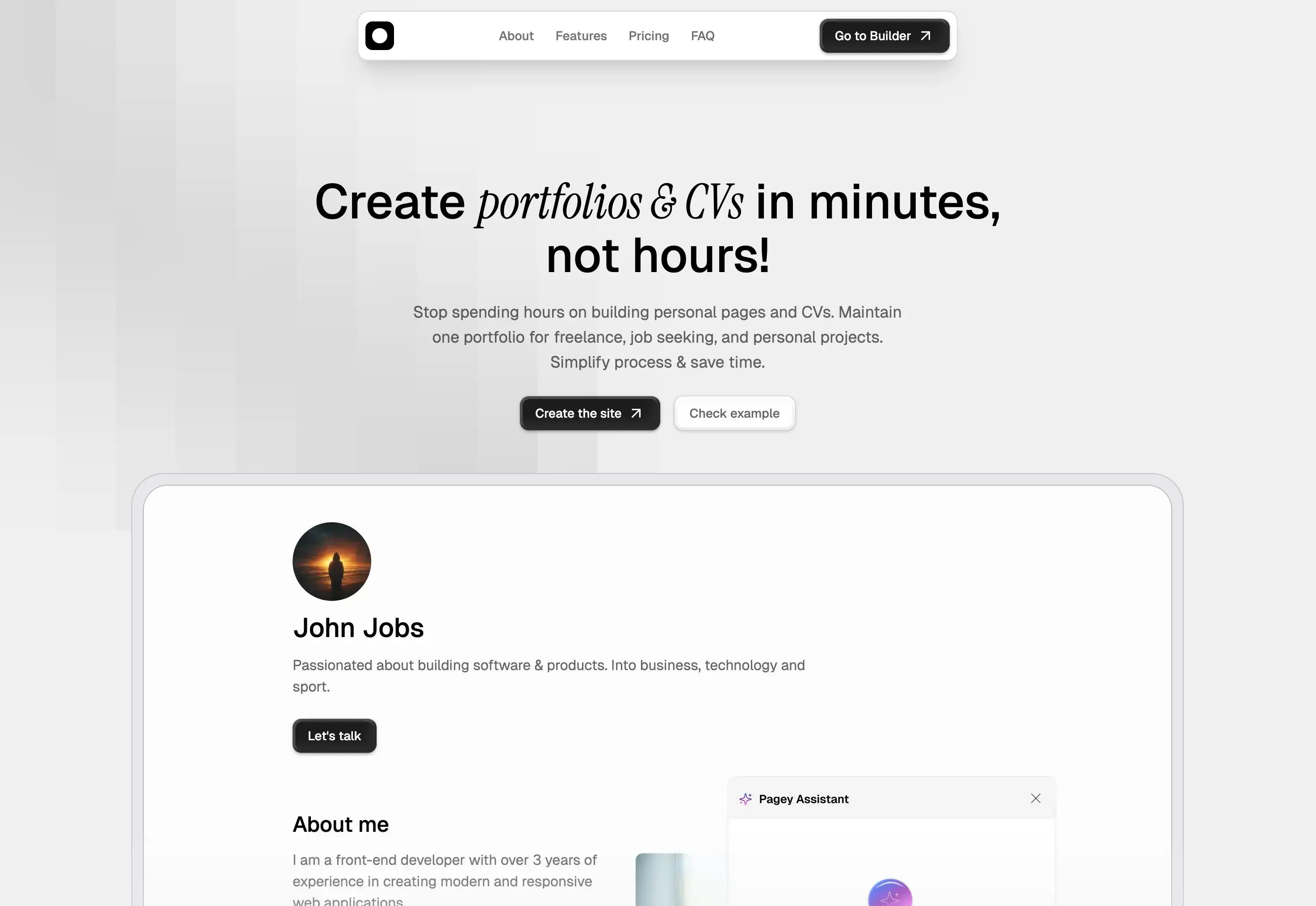
Current Pagey landing page
Our plan was to leverage our social media presence, X and LinkedIn, to get in front of our network. Additionally, I used Reddit communities, mainly for non-technical professionals (but not only), to show the possibilities of Pagey.
Another part of our strategy was to use product directories, such as Product Hunt, Peerlist, and others, to get some exposure. We scheduled simultaneous launches in the mentioned directories. We booked our entire day for the Product Hunt launch, to be prepared for replying and engaging with people. Our expectation was 15th-20th place and 75-100 votes.
Both Peerlist and Product Hunt launches went better than we expected, especially the PH. Pagey quickly got traction and had 100 upvotes after 4 hours. It gave us around 6th place after ranking disclosure and allowed us to fight for 5th place. People not only upvoted, but also commented. The launch gave us around 200 upvotes (came down to 179 after filtering out some of the accounts) and 5th place (I remember 7th, but that's what the dashboard shows me). Most importantly, we had around 1k people on the landing page thanks to that.
The results were much better than we expected, and it was not the end. Shortly after that, Pagey got mentioned in the biggest AI and tech newsletter, Superhuman AI, twice.
These two mentions gave us over 2k on the landing page alone. We got extremely excited, but we had to keep in mind that users would actually let us know if the tool stays or not, and we already had some signs.
Validation#
For us, a positive result of validation would mean: people would publish valuable pages, stick to Pagey, and share it with others. We were not only into views, but real value.
Despite having quite a lot of visitors, we knew that things did not go as well as we would have liked. The first sign was a low conversion rate (visitors that turned into users). It was below 1%, but it was not the most important factor. Users who did sign up did not create their pages, or if they did, they were not meant to be used.
It was not a dealbreaker yet, especially as at this time we got our first paying customer. Despite that, we kept investigating. The best approach was to contact users and talk with them directly. I had some calls and even more chats. After all of these interactions, there was one conclusion: they like what we built, but it's not what they are really looking for, and they would not use it long-term, nor pay for it.
This was a dealbreaker for us, as users decide if a product has value or not. If they told me directly that it's not, well, it means something. After discussion, we decided to provide some additional features, and call it a day, as we decided to move on. We really liked the result, and after some time I see that our users were right (but there are some that use it to this day) .
What we learned#
Well, some people would say that we lost, but I would not say so. First thing: we gave it a try, and maybe I could regret that we spent time on an idea that did not blow up, but it's not what I think. I think that the pain of regret that we have not tried it would be bigger, and I am happy we did it.
We learned a lot as well. There were a lot of new concepts and tech for us. Additionally we had the opportunity to go through the launch process, also on the marketing side. Combining it with all the data we collected from the product analytics tool, we have a lot of insights that we could go through and learn a lot from. Say what you want, but it definitely was not a loss for us. You cannot buy such an experience.
You can only lose if you learn nothing from the process.
Also, we did not act stupid and stopped the project once we got feedback that denied our thesis. We spent exactly the amount of time we were able to sacrifice to build the project and see if it works. And we pulled out several learnings. Next time I know to not focus on traffic, I would aim at retention and value.
My conclusion is to build something if you really want to do that. Make sure you will not regret not doing it, but keep your eye on the clock, especially if you seek user validation, make sure you build what they want and are willing to pay for. Nowadays, you are able to move faster than ever, with AI and unlimited access to knowledge. Use it, build and break things.
P.S. Clearly we dropped the solution, as you are in the portfolio that is coded by me, by hand.